Introduction: The Hard Truth About Your L&D Budget
As 2025 comes to a close, HR and L&D leaders across the Philippines are entering one of the most challenging planning cycles yet. Budgets are under scrutiny, expectations are rising, and leadership development is no longer viewed as a “nice-to-have.” It is expected to deliver measurable business value.

This is where many organizations feel the pressure. Despite continued investment in a leadership training program, senior leaders increasingly ask difficult but valid questions: How do we know this is working? What business outcomes are improving? Can we justify this spend in 2026?
The challenge is not a lack of effort or commitment. Most organizations are running leadership trainings regularly. The challenge lies in proving return on investment in a way that resonates with decision-makers. Without clear evidence of impact, even well-designed leadership training programs risk being perceived as cost centers rather than strategic assets.
This blog addresses that reality—and why removing guesswork from leadership development has become a critical priority heading into 2026.
Beyond Happiness Scores: What Is the Purpose of a Leadership Program?
One of the most common questions HR leaders continue to ask is: What is the purpose of a leadership program? Closely related are questions such as What are the aims of leadership training? and How will a leadership program benefit the organization?
Traditionally, leadership programs were evaluated based on participant satisfaction, attendance rates, or completion metrics. While these indicators are easy to collect, they offer limited insight into whether leaders are actually behaving differently on the job.
In today’s business environment, the purpose of a leadership training program has shifted. It is no longer enough to raise awareness or provide knowledge. Organizations now expect leadership development to contribute directly to outcomes such as:
- stronger manager effectiveness
- improved employee engagement
- reduced voluntary turnover
- clearer accountability
- better team performance
- more consistent leadership behaviors
This shift requires a different mindset. Leadership training must be treated as a strategic investment tied to organizational priorities, not as a series of isolated learning events. When the purpose of the program is unclear—or disconnected from business goals—measurement becomes difficult, and ROI remains elusive. Navigating this shift successfully begins with auditing leadership training value using structured behavioral benchmarks before launching new courses.
This is the point at which many HR and L&D teams begin reassessing not whether to invest in leadership development, but how it is designed and evaluated.
The Survey Reveals: Why 71% of Programs Fail to Show Measurable Value
Insights from the 2026 HR / L&D Trends Survey reinforce what many HR leaders already experience firsthand. Only 29% of organizations believe they can clearly demonstrate the value of their leadership development efforts. In other words, 71% struggle to show measurable impact.
This does not mean that leadership training programs are ineffective. Rather, it highlights a widespread challenge: organizations lack a consistent approach to linking leadership development to observable behavior change and business outcomes.
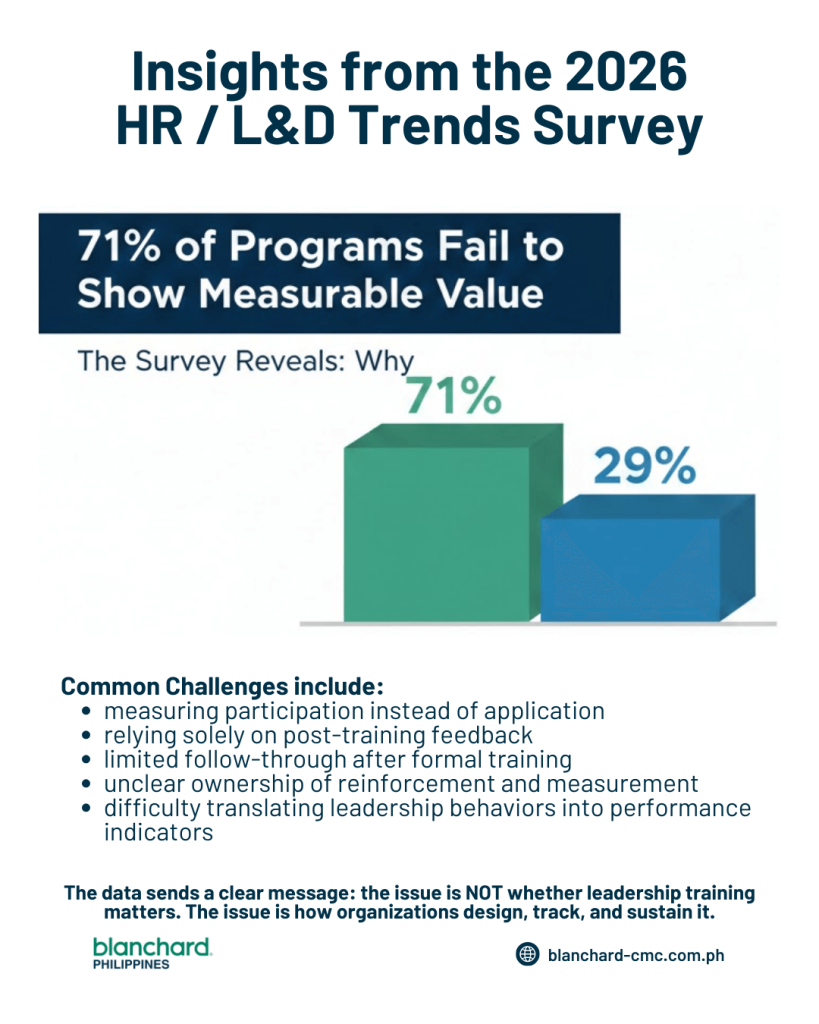
As a result, leadership trainings may be positively received but difficult to defend during budget reviews. For HR and L&D leaders, this creates frustration—especially when they know that leadership capability is influencing engagement, retention, and performance across the organization.


The 3 Strategic Steps to a High-ROI Leadership Training Program
Organizations that consistently demonstrate ROI from leadership development tend to approach it differently. While the full methodology requires customization, the strategic direction is clear. High-impact leadership training programs are built around three interconnected priorities.

1. Strategic Connection to Business Priorities
Leadership training delivers greater value when it is explicitly aligned to what the organization is trying to achieve. This includes clarity around which leadership behaviors matter most, which roles require development first, and how leadership capability supports broader goals such as growth, retention, or transformation.
Without this connection, leadership programs risk becoming generic and difficult to justify.
2. Measurement Focused on Behavior, Not Activity
Effective measurement goes beyond attendance and satisfaction. It focuses on whether leaders are applying what they learn and whether those behaviors are visible in the workplace.
Organizations that succeed in this area are intentional about identifying which behaviors to observe, when to assess them, and how to gather meaningful feedback. This creates a stronger link between learning investment and organizational performance.
3. Reinforcement That Sustains Change Over Time
Leadership development is not a one-time event. Without reinforcement, new behaviors fade quickly under day-to-day pressures.
Programs that generate ROI are designed with continuity in mind. They create opportunities for leaders to practice, reflect, and receive feedback, ensuring that learning translates into lasting capability rather than short-term enthusiasm.
Together, these three elements form the foundation of a leadership training program that is measurable, defensible, and aligned with long-term success.
From Guesswork to Confidence in Your Leadership Training Program
As organizations finalize their plans for 2026, this moment represents more than a routine planning cycle for HR and L&D leaders. Decisions made now will shape how leadership development is perceived in the year ahead—either as a strategic enabler tied to business outcomes or as an expense that becomes harder to defend under increasing scrutiny. The expectation is clear: leadership training must demonstrate purpose, alignment, and measurable impact.
The insights from the 2026 HR / L&D Trends Survey reinforce what many organizations are already experiencing. Leadership development remains a critical lever for performance, engagement, and retention—but only when it is designed with intention. Programs that lack clear business connection, meaningful measurement, or sustained reinforcement often leave leaders confident in the classroom but unsupported in practice. Removing guesswork requires stepping back to examine how leadership training is structured, evaluated, and reinforced over time.
For organizations preparing for 2026, this is the right time to take a closer, more disciplined look at leadership development strategy. Strengthening ROI is not about adding more training—it is about ensuring that what already exists is focused, measurable, and aligned with what the organization truly needs from its leaders. The full 2026 Leadership ROI Roadmap, and the insights behind it, are best explored through a strategic conversation. Connect with us to discuss how your leadership training program can deliver measurable, business-relevant results in the year ahead.
Frequently Asked Questions About Leadership Training Program ROI in 2026
1. What is a leadership training program and why does ROI matter?
A leadership training program develops leaders’ capability to drive performance, engagement, and retention. ROI matters because organizations must justify learning spend with measurable business outcomes.
2. What is the purpose of a leadership program in 2026?
The purpose of a leadership program is to build consistent leadership behaviors that improve employee engagement, retention, and team performance—not just knowledge or awareness.
3. Why do most leadership training programs fail to show ROI?
Most leadership training programs struggle with ROI because they measure attendance and satisfaction instead of behavior change and business impact.
4. How can leadership trainings become more measurable?
Leadership trainings become measurable when they are aligned to business priorities, focused on observable behaviors, and reinforced beyond the classroom.
5. Who should invest in a leadership training program?
Organizations planning for growth, retention, and performance in 2026 should invest in a leadership training program that delivers measurable, defensible results.
© 2025 Blanchard Philippines. All rights reserved. Unauthorized use, reproduction, or distribution of this content is strictly prohibited.