Managing Gen Z employees can feel challenging for Filipino managers. They may want frequent feedback, flexibility, faster development, and more involvement in decisions. But before labeling these behaviors as entitlement or poor work attitude, leaders may need to ask a different question: Are we managing them according to what they actually need to succeed?
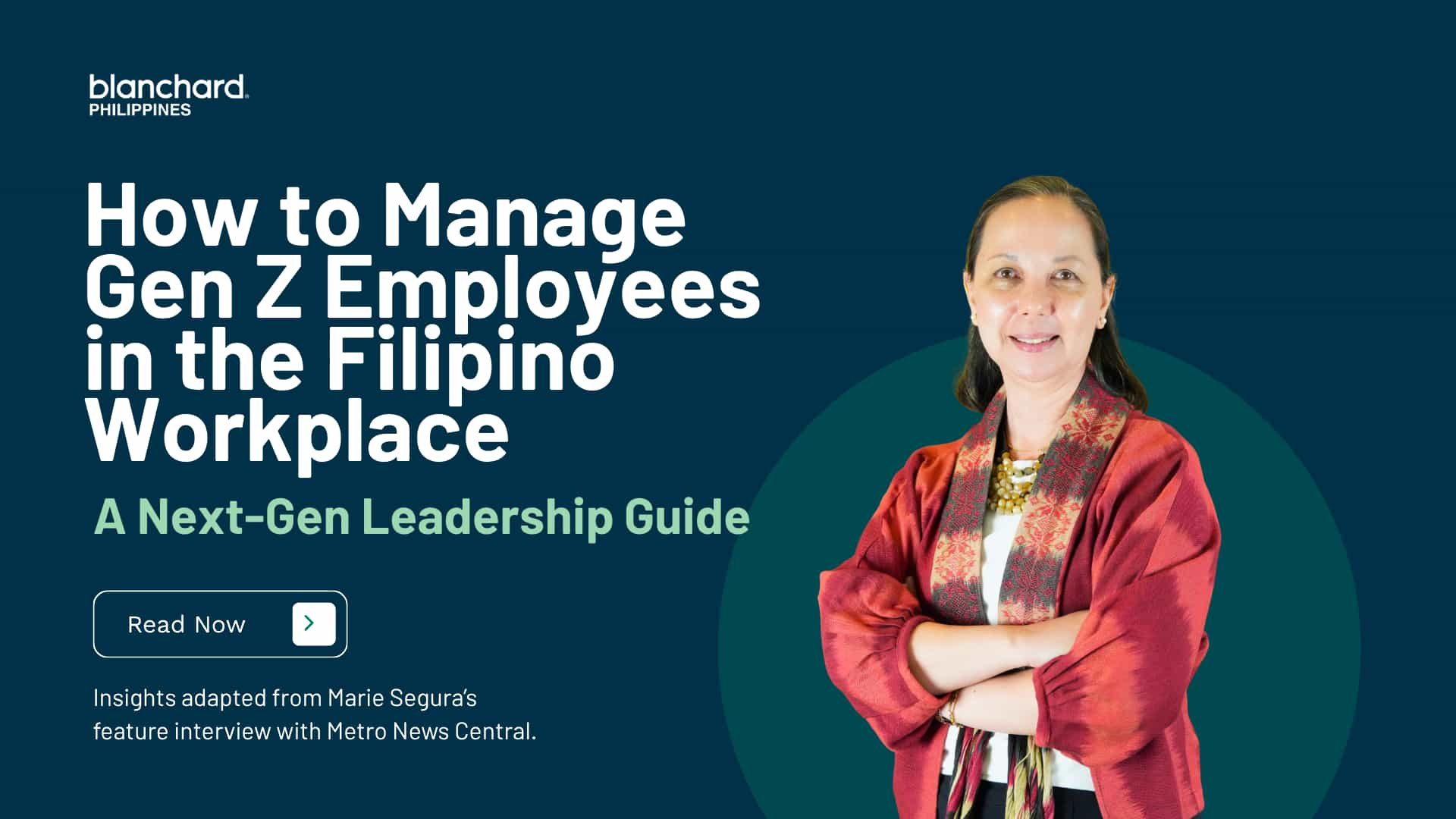
Marie Segura, Program Director for Leadership & Culture at Blanchard Philippines and CMC Business Solutions, recently shared her perspective in an interview with Metro News Central. Her message challenges the usual conversation around Gen Z management: the issue may not be the generation itself, but how leaders respond to people at different stages of development.
“I do not find that Gen Zs… intentionally want to make my life difficult.”
That perspective is important for any organization trying to build effective Gen Z leadership in the Philippines.
Gen Z Management Starts With Development, Not Age
A common mistake in managing Gen Z employees is assuming that everyone from the same generation needs the same leadership style.
Marie points to a more practical way of looking at it. People can move through different development stages whenever they learn a new task, take on a new responsibility, or enter an unfamiliar role.
Someone may be enthusiastic but inexperienced. Another may have gained competence but lost confidence. A more experienced employee may need much less direction.
Their age does not tell you what leadership they need. Their development level does.
This is where next-gen leadership becomes less about managing a particular generation and more about developing the ability to adapt. That ability also begins with developing greater self-awareness, helping leaders recognize when their usual approach may not fit the person or situation.

Why Feedback Is Not “Hand-Holding”
Gen Z employees are sometimes criticized for wanting frequent feedback. Marie sees this differently:
“I celebrate when someone desires feedback.”
For an employee still learning, asking questions can be a sign that they want to improve—not that they cannot work independently.
The practical challenge for managers is knowing when to direct, when to coach, when to support, and when to step back. This is particularly important for preparing newly promoted managers, who may now be expected to coach, delegate, give feedback, and develop others.
That balance is at the heart of SLII® (formerly known as Situational Leadership II®), representing Blanchard’s proven, practical approach to adaptive leading. It helps managers adjust their leadership behavior according to an employee’s development needs for a specific task.
The result? Employees can receive enough support to build competence without being unnecessarily micromanaged once they are ready for autonomy. This principle of adapting leadership to development needs has remained relevant across industries and changing workplace conditions for more than two decades.
The Filipino Workplace Needs Adaptive Leadership
This becomes particularly relevant in the Philippines, where respect for hierarchy and authority can sometimes make workplace conversations more difficult.
Employees may hesitate to challenge a manager, admit they are struggling, or raise a problem early. Managers, meanwhile, may assume that silence means agreement or understanding.
Marie describes how this can create a difficult cycle: employees hide problems, managers discover them late, and blame can replace development.
Next-gen leadership requires breaking that cycle.
Leaders need to create an environment where asking questions, acknowledging mistakes, and discussing challenges are part of learning—not reasons for embarrassment or punishment.
Establishing practical management for leadership removes supervisory guesswork by giving managers and employees a shared language to openly discuss task needs and accountability.

Developing Leaders for AI Transformation
The same principle applies as Filipino workplaces adopt AI.
One employee may quickly experiment with AI tools, while another may understand their potential but remain cautious. Someone else may need clear direction before using AI confidently in reports, workflows, research, or daily tasks.
The goal is not simply to tell employees to “use AI.” Leaders need to understand where their people are in the adoption journey and the human leadership skills that can help them move forward.
That is adaptive leadership in practice. Equipping managers with these situational capabilities ensures organizations succeed when managing digital and AI transitions across diverse, multi-generational teams.
Build Better Gen Z Leadership With the Right Development Approach
If your organization is struggling with Gen Z management, the answer may not be another generic program about how to manage younger employees. In fact, treating leadership development as a learning journey rather than a one-time seminar creates more opportunities for application, reflection, coaching, and follow-through.
It may be time to look more closely at how your leaders diagnose development needs, adapt their leadership, and create the conditions for people to grow.
That is where the right leadership training and development approach can make a difference.
We do not begin by selling a program simply because an organization asks for one. We first look at the leadership challenge, the people involved, and what the organization actually needs. From there, we help build a learning journey that supports leaders beyond theory and into real workplace application.
If you want to develop leaders who can manage Gen Z, multigenerational teams, and a rapidly changing workplace more effectively, contact us to explore a leadership development approach tailored to your organization’s needs.
Source:
This article draws on insights shared by Marie Segura in Metro News Central’s interview, “Is Gen Z Really Difficult to Manage at Work?” Read the original interview on Metro News Central
FROM INSIGHT TO IMPACT.
Work with us to equip your leaders with the mindset and skills needed to succeed in today’s evolving workplace.
© 2026 Blanchard Philippines. All rights reserved. Unauthorized use, reproduction, or distribution of this content is strictly prohibited.