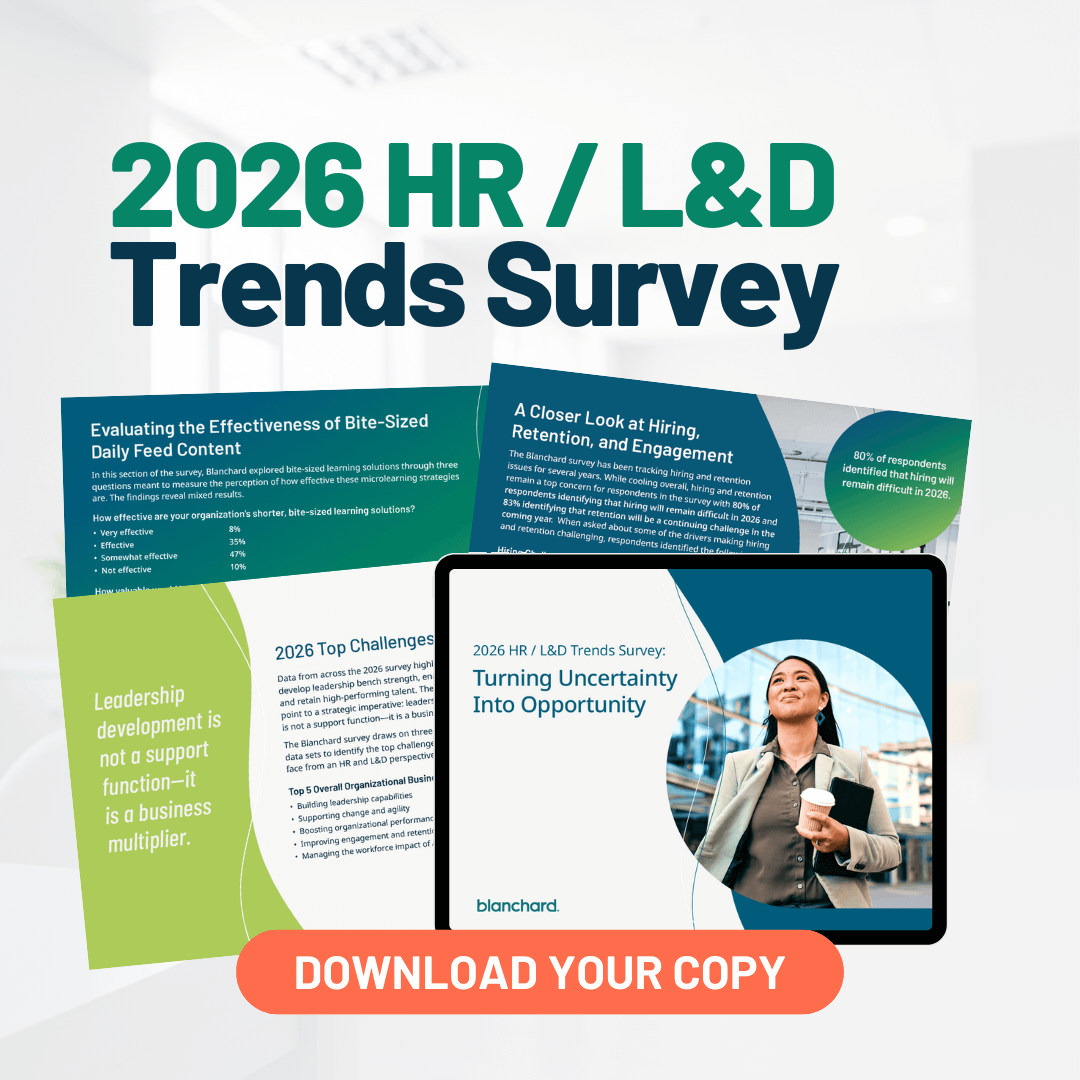
If you are researching leadership competencies 2026, future-ready leadership skills, or the most effective leadership development trends 2026, one pattern is clear: technical expertise is no longer enough. Organizations are prioritizing coaching, communication, adaptability, and cultural intelligence as core leadership capabilities. The 2026 HR / L&D Trends Survey shows that coaching and mentoring (48%) and communicating effectively (47%) are the top competencies leaders must strengthen this year.
The question for HR and L&D leaders in the Philippines is not whether to build these skills — but how to develop them systematically.
The answer lies in servant leadership. Not as a philosophy, but as the operating system behind future-ready leadership.
The Top Leadership Competencies for 2026

Section Three of the 2026 survey highlights the top six leadership competencies organizations are prioritizing:
- Coaching and mentoring people (48%)
- Communicating effectively (47%)
- Leading change initiatives (40%)
- Adapting to new challenges (38%)
- Developing people’s skills (34%)
- Leveraging AI and emerging technologies (33%)
These findings reinforce a critical insight: leadership is now relationship-driven and human-centered.
In Filipino organizations — whether in manufacturing, BPO, banking, healthcare, or government — leaders operate in environments shaped by rapid digital transformation, hybrid work, and multi-generational teams. Authority alone does not drive results anymore. Influence does.
Servant leadership strengthens each of these competencies by redefining leadership as service to performance, culture, and people development.
Why Coaching Is the #1 Leadership Skill
When 48% of organizations rank coaching as the top leadership skill, it signals a structural shift in how leadership effectiveness is defined.
However, coaching capability is frequently misunderstood.
Many managers equate coaching with giving advice or holding informal check-ins. True coaching-based leadership requires disciplined questioning frameworks, emotional intelligence calibration, and consistent developmental dialogue structures.
Effective coaching leadership training equips managers not only to:
- Ask powerful, forward-focused questions
- Develop problem-solving capability within teams
- Build accountability without micromanaging
- Conduct structured growth conversations
—but to execute these behaviors consistently across performance cycles, career milestones, and change initiatives.
Without structured practice, observation, and reinforcement, coaching behaviors often revert to directive management under pressure.
Developing coaching as a leadership capability requires system-level integration—not occasional reminders.
The Role of Empathy in Change Leadership

Change fatigue is real. The 2026 survey underscores agility and transformation as central organizational priorities. But change fails when leaders communicate without empathy.
Empathy in leadership does not mean lowering standards. It means understanding how change impacts people’s workload, morale, and psychological safety.
Servant leadership strengthens change leadership by:
- Connecting strategy to individual purpose
- Listening before implementing transformation
- Clarifying the “why” behind business shifts
- Reinforcing resilience through transparency
In Filipino workplaces, where collective identity and harmony are highly valued, empathetic change communication reduces resistance and increases alignment.
Leaders who balance performance expectations with human understanding create sustainable change.
Adaptive Leadership vs Command-and-Control
Traditional command-and-control models struggle in unpredictable environments.
Adaptive leadership requires:
- Quick decision-making under uncertainty
- Emotional regulation during pressure
- Flexibility in approach
- Openness to feedback
The survey identifies adaptability (38%) and leading change (40%) as critical competencies. Servant leadership supports adaptability because it encourages learning agility and reflection.
Rather than defending outdated processes, servant leaders continuously ask:
- What does my team need now?
- How can I remove barriers?
- What skills must we develop next?
This mindset builds resilience across leadership levels.
Developing Cultural Intelligence Through Servant Leadership
Future-ready leaders must lead diverse teams across functions, generations, and sometimes regions. Cultural intelligence is no longer optional. The 2026 findings emphasize empathy, inclusion, and trust-building as emerging leadership themes.
In the Philippines, where workplaces often blend global standards with strong local relational dynamics, leaders must balance structure with sensitivity.

Servant leadership naturally strengthens:
- Inclusive communication
- Psychological safety
- Recognition culture
- Cross-functional collaboration
Cultural intelligence becomes practical when leaders intentionally practice listening, perspective-taking, and fairness.
Leveraging AI Without Losing the Human Connection
Technology is accelerating. Thirty-three percent of organizations identify leveraging AI and emerging technologies as a required competency.
However, the survey also emphasizes that human-centered leadership remains foundational.
Future-ready leaders must:
- Integrate AI tools responsibly
- Maintain ethical standards
- Ensure technology enhances, not replaces, human judgment
- Protect team engagement amid automation
Servant leadership keeps technology grounded in purpose. It ensures that productivity gains do not erode morale.
Human connection remains the differentiator.
Building Leadership Bench Strength Through Development Journeys
Sixty-nine percent of organizations prioritize developing leadership bench strength. Yet only about one in five rate their development quality as high. This gap is significant.
Future-ready leadership development must:
- Start early (emerging leaders, frontline managers)
- Be reinforced through coaching and feedback
- Include practical application and accountability
- Align with measurable business outcomes

Programs such as Servant Leadership Essentials™ provide a structured foundation for coaching, communication, and trust-building — the exact competencies highlighted in the 2026 trends.
Leadership excellence does not happen through isolated workshops. It requires integrated journeys.
Designing a Blended Leadership Learning Strategy for 2026
The survey shows learning delivery will remain blended:
- 41% in-person
- 29% virtual instructor-led
- 30% self-paced
However, delivery format alone does not determine effectiveness. The more critical differentiator is architectural alignment.
Fifty-nine percent of organizations prefer customized solutions—yet customization without structured methodology often results in fragmented initiatives that fail to shift leadership behavior.
Future-ready leadership development must integrate:
- Research-backed servant leadership frameworks
- Customized, culturally relevant scenarios
- Reinforcement cycles that extend beyond workshops
- Behavioral metrics tied directly to retention, engagement, and succession KPIs
This requires careful sequencing across leadership tiers, measurable checkpoints, and accountability structures embedded into talent systems.
Blended learning is not about modality. It is about sustained behavioral transformation.
How to Develop Future-Ready Leadership Skills in 2026

If you are evaluating how to develop future-ready leadership skills in 2026, the data is clear: coaching, communication, adaptability, and cultural intelligence must be strengthened systematically. Servant leadership serves as the operating system that integrates all these competencies into daily behavior.
But identifying competencies is only the first step.
To truly build future-ready leaders, your organization needs a structured, customized leadership development journey that aligns with your culture, talent pipeline, and strategic goals.
Schedule a leadership capability strategy session to assess your current competency gaps, coaching readiness, and cultural alignment. We will help you design a servant leadership–based development journey that transforms critical competencies into measurable performance outcomes.
© 2026 Blanchard Philippines. All rights reserved. Unauthorized use, reproduction, or distribution of this content is strictly prohibited.